Tuesday, December 27, 2016

Stella finds her first truffles!


Stella is so proud!
Stella finally found her first truffles in the wild, unaided by me, all thanks to Alana McGee, owner of Truffle Dog Company. Tomorrow we go out again, and again and again, because truffle hunting is a team sport. My job is to encourage Stella, to know when she is telling me where the truffle is, and to be able to find it myself. They are hard to see in the forest duff, and meanwhile Stella is off looking for another one as I sift through the dirt. 

Did I ever tell you the story of how I got Stella? 

I was in Port Townsend, feeling sorry for myself because I was lonesome on the farm, and my friend Michele suggested getting a dog. I had never had a dog, being very allergic to them, but I was willing to try. About that time a pair of beautiful curly dogs came walking down the sidewalk right in front of us. "Those look like Portugese Water dogs", Michele said, "and they are hypoallergenic!" We stopped the owners and soon found out they were Lagotto Romagnolos, even more hypoallergenic. I asked if I could bury my face in their fur. This I did for a few minutes, with no reaction. Patti Fischer and her husband Leonard were very obliging, and said they had just gotten the female and were thinking of breeding her with their intact male. I gave them my card, and said if they decided to breed them, I would like to buy one. Three months later they called me from their home in Sequim and let me know I was third in line for a pup. 

In August, when the puppies were 6 weeks old, I was asked to come to Sequim to choose one. I had been trying out Italian names all summer, and settled on Fabrizio if it were a boy, from the movie 3 Coins in a Fountain, where Jean Peters, astride a Vespa, waves her hand as she zooms off, saying "Arrivedella Fabrizio!" If a girl, Stella, for the wonderful character in Tennessee Williams' "A Streetcar Named Desire".
Once there, two pups out of the litter of six held my attention. Both apricot colored, the boy was the breeders' choice for me, but the girl wanted me. I could not make up my mind, but had to, since all of the puppies were sold and needed to be chosen. We decided to stay in Sequim for the night, in case I wanted to come back in the morning. I said I would sleep on it, and know by then. At the hotel, after dinner, it was 9 o'clock when I turned on the tv. It was tuned to PBS, it was Saturday night, and it took me a minute or two to realize that the film playing was "A Streetcar Named Desire". Whoa, must be a sign!. I had not seen that movie in 20 years. Suddenly the nighttime downtown scene of flashing neon lights filled the screen, and there, at the top, was the word "Riley's", in big, flashing lights. I picked up the phone and called the Fischers. Stella was my dog. 


Sunday, April 24, 2016

Raquel Ruis Diaz Comes to Nettles Farm

Changes at Nettles Farm


Raquel Ruiz Diaz, Chef Blaine Wetzel's longtime partner, is lending her considerable hospitality skills to Nettles Farm. As my duties at Lummi Island Wild Co-op increase, I see the need for a steady hand and watchful eye at the B&B, so that the quality of the experience stays strong.

Raquel, who was badly injured in Paraguay a year ago last Valentine's Day, is continuing her complete recovery. While she cannot yet resume the long hours on the floor at the Willows Inn, she is super capable of taking care of the small but important details at Nettles, as well as organizing future workshops and other events. It has been my pleasure to work with her since 2010, and the past few weeks have been a reminder of how much she has to offer.


My work at Lummi Island Wild Co-op has increased several fold as we move into buying halibut and spot prawns, as well as Fraser River salmon, from the Lummi tribal fishers. We marketed the halibut as Salish Sea Halibut, since I have known for many years how much better the flavor and texture of this halibut over Alaska or other Pacific halibut. Its diet is spot prawns and dungeness crab, and it is reflected in the bluish translucence of the flesh, as well as the gigantic flavor. Here are some pictures from the last few weeks.

Salish Sea Halibut Raquel aboard Lummi Island Wild's new tender, the Galactic Ice

Salish Sea Halibut, and Raquel aboard the Lummi Island Wild tender, Galactic Ice

Night time tribal halibut delivery aboard the Solar Ice, Lummi Island Wild's tender

Night time Tribal halibut deliver to Raquel, Stan, and me on the Solar Ice

We have developed a new online store for our Lummi Island Wild products, including the halibut from early this month. Check it out at http://www.lummiislandwild.com/shop/.

Stella is very very close to finding truffles in the field. She can locate 100% of the buried truffle hides now. The next step is to take her out on a truffle field workshop, to translate that skill into the real world. It's more for me than for her.

We planted more than 100 blueberry bushes near the raspberries, and black currants as well. With the amazing spring we are having, pollination is super high, and I expect plenty of berries, Asian pears, and apricots, as well as kiwis this season. Remember, they are yours to pick when you come at the right time!

Stella and Kitty, last year, and this year. Best friends forever.


We are going to be raising our rates in the next few months, as we see how things will shake out with Raquel and other farm staff. If you have plans to come this year, book now and your rate will remain the same.

We are able to accommodate larger groups in each of the suites, if we have advance notice, by opening up the upstairs bedrooms and bathroom, all accessible from either side. As usual, the rate for extra guests is $50/person. Thanks for sticking with me these past years, and I look forward to seeing you again soon. Riley

Tuesday, June 2, 2015

Truffle Dog Company's Alana McGee and Kristin Rosenbach with Stella
The founders and owners of The Truffle Dog Company, Alana McGee and Kristin Rosenbach, visited Nettles Farm last weekend. The purpose was to see if, even in the drought we have had all May, we could find some truffles on and near the farm. They brought out their trusty dogs, a Lagotto and an Australian Shepherd, and off we went. Several areas were likely spots, but we found them in only two. Altogether we found 3 truffles, a minor miracle given the dry soils everywhere we looked.
Oregon Black truffles, found on Lummi Island


Now we are taking the online truffle class that they offer with  earnest desire and a solid goal: Stella will become like her ancestors of 600 years ago, a truffle hunter!


The work I have been doing with Poulet Bleu and chicken workshops received some recent press: The Wall Street Journal just after Christmas, and The Huffington Post two weeks later.
I got a puppy in September, a Lagotto Romagnolo named Stella (the truffle Smella), named for the character in A Streetcar Named Desire. STELLLL-A!!! We are training each other in the art of being and having a dog.....neither one of us has been here before.... and the learning curve is steep. I enrolled her in a truffle hunting class, which we are just beginning. I went truffling with a fellow named "Animal", a forager with a Lagotto named Austin. We found $100 of good black and white truffles (he had a drug truffle scale, $20/gram) over an hour of trudging through underbrush in the pouring rain, in a public forest near Issaquah. The drive back home was infused with the warm, comforting aroma of truffles, so pleasant I was surprised by the experience.This quickly inspired me to get serious with Stella.
The goats have found a new home. Rosy was going after Stella. Nico was going after all children, lately with more purpose. They are together on a hobby farm in the county. I miss them and so does the feral cat that, unbeknownst to me, was living with them on the sly. I have been feeding the cat for the past year and a half, hoping to make friends with it (you can see I was lonely...I hate cats), and it would show up unexpectedly and I would put the food bowl closer and closer to my back deck. It was so skittish that if I looked its way it would bolt. Finally, the cat, whom I named Cosette from Les Miserables, because she was definitely a survivor, allowed herself to eat from the bowl on the deck. When I rehomed the goats, Cosette started showing up more and more, and I would see her in the goat pen wandering. She spent a lot of time with the chickens, too, and I finally realized that she had been spending all of her time on the farm, with the animals. When I got Stella, Cosette could not get enough of her. Over a few months Cosette, who turns out to be a boy (he must have been just a kitten when I first fed him), continued to engage Stella and to be passive and inviting. The result is that they are best friends, and all without a single word being spoken!

I hope you find the time to come for a restful stay sometime soon! We'll all be waiting.

Thursday, January 2, 2014

In Search of the Perfect Chicken: Burgundy

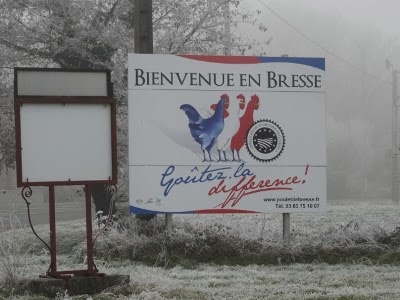
We enter the Bresse AOC
The Saone River in Burgundy divides the region into two distinct geographical areas. To the west, the rolling hills of the Grande Cru wine country, where Montrachet, Puligny, and Mersault burgundies are created by God and man. To the east, the flat farmy plain of the Bresse AOC, home of the poulet de Bresse. Every mid-December since 1862, this region has celebrated the noble chicken that defines French character in silhouettes, images, and sculptures thoughout France. The festival, held in Bourg-en-Bresse, is called Les Glorieuses, and is the focal point of the holiday buying season for restaurants and individuals alike. In the week before the festival, all of the area farmers can be found processing and wrapping capons, hens, and other poultry in anticipation of their busiest sales season. Below the owner of a small farm is working with 3 or 4 of his helpers, doing the "roulage" on his capons, sewing a tight cover over the carcass to keep the fat nice and even. The head, feathered neck, intestines, and everything else, is still in the bird. In this manner, the chickens can be aged for up to 21 days, and when a chef prepares the bird for the New Year's feast, the flavor is very good. 
A farmer sews the roulage over his capon.


The judging for the chickens is about consistency in size, skin color and fat. The best birds are sold to the highest bidder, and by the end of the day, all of the birds have found homes in (mostly) restaurant kitchens. 
Prize winning hens
The judges display their gravitas.

Guinea fowl at their best
Customers take the chickens away.


Tuesday, October 22, 2013

Dante, the Fearless Warrior Rooster


Dante, also known as Raphael by his hens, and who answers to neither name, is the sole rooster in charge of 40 laying hens. He is a Sulmthaler, and must weigh 12 lbs. He is a good rooster, and takes his job seriously. Whenever a dispute breaks out between 2 hens, which is often, especially with Plymouth Barred Rocks, Dante rushes from whatever far corner of the fenced area he occupies to get between the battling hens. He finds the highest perch he can, usually in a fruit tree in the yard, to oversee his domain. His crow is loud and clear, leaving no doubt that he is in charge.
One day a few months ago, before the unfortunate incident with Pico the hen, the young goshawk had the audacity to attack one of the hens. Now these hens are large birds, easily weighing 8 lbs, and the hawk could not have been more than half that size. But still he rocketed down from a nearby perch and landed on the back of the Barred Rock. Dante instantly came running like a giant orange ball of fury, and shoved the hawk off the hen. The hawk, feathers obviously ruffled, flew back to his perch, before swooping down on Dante when his back was turned. The hawk clawed all the feathers from poor Dante's back, but was no match for the giant rooster. Dante upturned the predator, and chased him from the yard.
That was almost Dante's final effort though, for he was so weak he could walk only by using his wings as crutches. With all the strength left in him, he made it to the coop door and safety, his back bleeding profusely. As proud as he was, when I detached the automatic waterer and put it in front of him, he drank gratefully. The hens, being hens and not knowing any better, began pecking at the red blood and would have finished the hawk's job unknowingly if I had not put a plaster of coal tar all over his back.
Days later, Dante could barely get around. Instead of roosting high overhead in the coop with a few of his favorite hens, he stayed alone on the floor, his head pressed into a corner out of shame. In the following video, taken a few days after the attack, he still is so weak he slumps to the floor to eat his grain. Crowing is out of the question, as is flying or even climbing up to a roost.


Now, a month later, Dante is back on top, crowing, perching from on high, and warning of danger as he has always done. Well done, Dante the Warrior!

True Life Adventures of Rosie the Goat, Queen of Nettles Farm

In every goat herd, there is one alpha female called the queen goat. Even though Rosie only has a herd of one, her rather dufus brother Nico, still she takes her job seriously. She is fussy with her food, checking out this plant and that to see if it is safe to eat. She wanders the pen looking for ways to get out, eager to show her brother the new path. She makes sure the herd is together, and that includes me.


Some weeks ago, Rosie showed us what a good mother she might be if given the chance. I was moving a small flock of adolescent Sulmthaler chicks, which were living in the same building as the goats, when one small hen flew straight up and out of the pen. It was so quick I tried in vain to catch it. As I chased it, the chick found a way out so small I couldn't follow. I tried to lure it back in the next few days, but it was so skittish she would run back to her little hole when she saw me coming. Days went by and I didn't see her, and the food I left was untouched. I was sure an owl or a raccoon had gotten her, until one morning I went to feed the goats, and there was the tiny hen, perched on Rosie's head. The little bird felt safe there, and figured out how to get some of the grain from Rosie's feeder. As the weeks passed, the hen, who we called Pico, was inseparable from her "mom". When we took the goats for a walk, Pico would cry and cry to see Rosie leave.

This went one for about a month, and Pico had grown from a small chick into a healthy adolescent. She traveled everywhere on Rosie or Nico's back. This did not go unnoticed by a young goshawk who had been terrorizing the layers and other hens around the farm. Normally we do not see goshawks here, as their habitat is usually north, but occasionally one will join the ravens and eagles that give an interested flyby when they hear the sound of young chickens. One day, while I was inside working, the hawk swooped low and snatched Pico right off of Rosie's back. Rosie froze as she heard her little friend crying through the trees, then silence. That was almost a month ago, and still Rosie seems traumatized. She is hesitant to leave her pen, and for the longest time looked in vain for Pico, with a caring and bewildered look in her soft eyes.

Tuesday, April 16, 2013

Four Leaf Clover

I am one of those people who find 4 leaf clovers. I can walk along a path, spot a patch of clover, and there will be the anomalous oddball calling out to me. I'm not sure why they matter to me so much; I've always looked for them, and I have a hard time passing by a clover patch without pausing to look. My day looks a little bit brighter, my step a little peppier when I find one.
Lately I have taken to keeping one on my window sill in an old bottle I found on 39th St. in Bellingham a long time ago. Embossed on the front is "My Mother's Salad Dressing", from Chicago, Ill. It's a beautiful artifact, and I found both a large and small one in the little refuse pile I unearthed while on my backhoe digging a ditch. It was said that a "goat woman" lived on the property during the 1930s, and this was all that remained of her life there. She must have loved the salad dressing, as there were scores of bottles there, but most were ruined by the backhoe before I realized what I'd found. I often think of her when I look at the clover, and what we leave behind, and what she might have left behind coming to Fairhaven and living with goats. Now that I have goats, I realize that they can be good companions! But what was in the salad dressing that she ordered it from Chicago instead of making it herself? Maybe it was a vestige of the life she lived in earlier days, a celebratory splash of dressing as she sat to eat her greens.


Wednesday, April 10, 2013

The Birds Sing

"The birds sing, at the break of day. Start again, I heard them say. Don't dwell on what has passed away, or what is yet to be....."  The words are from Leonard Cohen's Anthem, and as I awaken early, and listen to the robins sing in a spring dawn, I am reminded of waking up as a 6 year old on a little suburban Everett farm. Two and a half acres of amazing productivity. I can hear the very same melodious, cavorting, sweet and intricate songs as I lay in bed, eagerly wondering what awaited me that morning. We had a cow, Mildred, and a boxer, Spike, and 10 rows of raspberries to weed. We had 4 cherry trees, 3 apple trees, 2 pear trees, and a blackberry patch that was both fearful and wonderful.
But I also had a special friend, a neighbor whose house was next to ours, accessed by a winding path through salmonberry and snowberry bushes. Her name was Dora Studeman, and when I met her she must have been in her late 60s. Her husband of many years had recently died, and she must have been at such a loss, since he had been wheelchair bound for many years before his death, and she had no other family. We were kindred spirits from the start. I, the middle child of 6, was full of wonder and excitement, and so was Mrs Studeman. She showed me how to garden, how to eat what we had grown, and it is to her that I owe the life on Lummi Island that I now inhabit. Perhaps unconsiously, I have been recreating the garden that she had, and the life as well. I remember her giant gooseberry bush, the glorious tomatoes, the berries and the fruits, and as I watch my cherry trees bud, and my red currants and my gooseberries, I think of her, with her scratchy white haired voice full of kindness and love. And I think of my 6 year old granddaughter, Madeleine, and hope that I can be a beacon for those same instincts in her.

Tuesday, April 9, 2013

In Search of the Perfect Roasted Chicken

These hens are my 40 layers, all supervised by a 12 lb Sulmthaler rooster named Dante by Susan  Bennerstrom. We all thought that it was a hen when she named it; we didn't know what to expect from the 11 chicks we hatched from 20 eggs we bought from Arizona. Dante was gray as a youth, and since we couldn't believe we only had 3 hens out of 11 chicks, we assumed the grey ones were hens too. Turns out there are Black Sulmthalers and Grey Sulmthalers, and we did surely have 8 males and only 3 females. Not a great start to the Sulmthaler Club: In Search of the Perfect Roasted Chicken.
I first heard of these Austrian birds from an Austrian farm couple who came to the US to help introduce Mangalitsa pigs to this country. Ron Zimmerman from the Herb Farm brought them to Woodinville to teach a butcher class using a total of 5 Mangalitsas imported from Hungary by Heath Putnam and raised by Ron. PigStock 2006! This master butcher, Christophe Wisner and his wife Isabel, showed a group of us over 3 days how to "seam" butcher a hog, using only a knife and no saw. It was an amazing workshop. Anyway, after the class the Wisners came up to Lummi Island to stay with me at the Willows Inn and visit Nettles Farm, as I had a Mangalitsa and I was anxious to hear their advice on how I was raising it. It was then that they casually mentioned that they also raised Sulmthaler chickens, a rare bird that they feared might go extinct, since it took nearly a year to mature, but dressed out at 6 lbs. From that moment I could imagine the incredible eating experience such a bird must offer. Imagine, a year old and 6 lbs! Since the best birds I had had up until then were only 14 weeks old, and older means more flavor, my fantasies soared.
It was years later when my friend Ed Gulyas texted that he had found some Sulmthaler eggs for sale, but they were $25 each. We took a collection among our chicken loving friends, and everyone put up $100 to each receive, at the end of what might be 2 years, 2 wonderful, magnificent roasters. As I speak, there are 3 breeding pairs in separate chicken tractors, and 24 (make that 22- a renegade raven killed and ate 2 when I dared to let them out of their shelter) adolescents of varying age roaming one of the fields. It will be a year May 10 from the first hatch. We have eaten 4 rooster culls, at 9 months, and though they were only 4 lbs, they were tender and delicious, so I do believe we are onto something. And Dante? He is very happy, for not only does he have a harem of 40, but he is not destined for the pot. Suse made me promise.


 .

Monday, April 8, 2013

Roasting Coffee

I have begun roasting my own coffee, not only for myself, but also for my guests. My friend Ed Gulyas turned me on to this; he's been doing it for a long time and I have had many wonderful and subtle coffees from his countertop Pavoni. It wasn't until I really began to inhabit Nettles Farm by myself that I slowed down enough to take the time to do it. I bought 20 lbs of green coffee from Sweet Maria's, an Oakland company that really knows and cares about the coffee they purchase and sell. It costs a little less than half the price of  roasted beans. Green coffee gets better as it ages, unlike roasted beans, and drinking a brew from freshly roasted coffee is truly a peak experience.
Ed gave me an old popcorn popper he had bought thinking he would go through one every few months, when in fact his first one is still going strong years into it. It is messy, as the beans go through their first "crack" and shed their outer covering as they roast. Also it creates a lot of smoke and smell, fairly strong smell. First I roasted under the hood of the FarmHouse Suite, and that worked really well, but there was clean-up involved. Now I have the popper and the cooling pans on a sheet pan outside on the deck. Ed is very picky about his roasting, and brings the beans just to their second crack, then immediately cools them down using a second popper with no heating element. I like a dark roast, not only for flavor, but also because there seems to be less caffeine in the brew. So I let the beans go through their second crack, until they are very dark and shiny from the oils released, then dump them into a bowl, where I cool them slowly by pouring them from bowl to bowl. Right now I am roasting Mocha Kadir, which is fruity and smooth.
I make my coffee with a Delonghi Magnifica, and automatic espresso maker that makes surprisingly good espresso. Starbuck's had a sale on them some years ago and I thought I would try it. It took awhile to get a good cup, but you can tweak it to make what you like.
For ease of use, I have fresh beans, a good grinder, and a French Press in each of the rooms. I am setting up the commercial single group Astoria that I have in the carport, so that guests can use it if they want. I can also teach guests how to make a good cup if they don't know how, which is fun if you have never used a commercial machine before.

Sunday, April 7, 2013

New Life at Nettles Farm

After what seems like a lifetime away, I am giving up on the life of a bon vivant, and find myself hard at work at Nettles Farm once again. I have come full circle since the spring of 1992, when I first began to develop the property, which was just trees, stumps, and, well, nettles. Then I dreamed of showing the world that this corner of the world could grow good tomatoes, that we could vote with our feet and stop complaining and just do something. Now, since the point has been well made, I am content with growing good tomatoes for my guests. Along with asparagus, raspberries, blueberries, rhubarb, peas, salad greens, eggs, gooseberries, tree fruits, and exotic chickens, that is. My goal is to treat the guests in my two B&B rooms to a taste of Nettles Farm on Lummi Island. I had forgotten how wonderful it is to wake up to the good air, good water, quiet surroundings. Today I could hear the crash of breakers on the beach from the strong westerly winds as I went about my day. Earth and Sea. What a treasure!
For the past 12 years I neglected the farm in order to promote the Willows Inn, down the hill from me, but that is all behind me now, as told in Outside Magazine. I have the privilege of walking the farm, tending the fields and animals, and talking to guests every day now, and watching as the demands of each living thing growing at the farm change with the seasons. It is a chance to slow down, pay attention, and to give needed care without rushing that leads me to think that this could really be a fine retirement.
This month, guests coming to Nettles Farm can expect to find beautiful tender broccolini, salad greens, fresh eggs, rhubarb, spinach, asian greens, and lots of herbs, all free to be picked for dinner. The hope is to maintain a kitchen garden that guests can peruse before deciding what to cook for dinner.